


How to Stop Destructive Behavior in Cats: Helpful Tips

Photo by Daniel Zopf on Unsplash
You love your feline friend, but she can do some major damage. Between scratching everything in sight and chewing on all your houseplants, your cat can wreak havoc on your home!
Here, we’ll talk about how to stop destructive behavior in cats, why they do these things in the first place, and what to avoid when you’re trying to train your kitty.
The Takeaways
The most common destructive behaviors in cats include scratching, sucking and chewing on fabric, and nibbling on houseplants.
To stop destructive cat behavior, understand the behavior, provide stimulation to prevent boredom, interrupt the unwanted behavior, keep valuable or dangerous items out of reach, offer alternatives, repel your cat from off-limit things, manage teething, and seek professional help when needed.
Avoid physical punishments, forcing good behavior, throwing out old scratching posts, and declawing your cat.
Table of Contents
Common Destructive Cat Behaviors and What Causes Them
How to Stop Destructive Behavior in Cats
What to Avoid
Common Destructive Cat Behaviors and What Causes Them
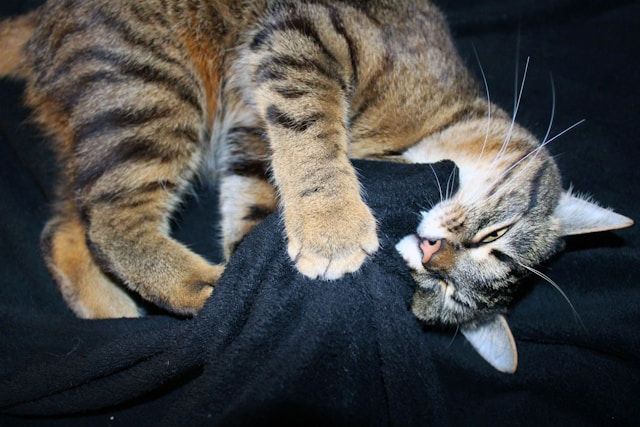
Photo by Oleksandr on Unsplash
The important thing to remember is that your cat isn’t being vindictive or trying to aggravate you when she rips up your curtains or demolishes your favorite plant. She’s simply being a cat!
Unfortunately, cat behavior that would be considered completely normal in the wild can be super destructive inside your home. Let’s take a look at why your cat does what she does.
Scratching
Scratching comes as naturally to cats as grooming. It’s simply in their genes! Cats scratch for lots of reasons, including:
To stretch their legs
To sharpen their claws
To mark their territory
To show their confidence
Trying to stop your cat from scratching altogether is pretty much impossible, as well as unhealthy. Cats have an innate need to scratch; that’s not something you want to (or even can) curb.
Sucking and Chewing on Fabric
This one is a little more complex. Sucking and chewing on fabric isn’t as common in cats as it is in dogs, but it does sometimes happen.
First, chewing is completely natural for kittens. Like puppies, they might chew on different things as they play and explore. After all, they’re new to the world and still learning their environment! Most cats outgrow this, but some don’t.
For those that don’t, chewing and sucking on fabric specifically might be a way to comfort themselves. It’s also thought to be a genetic disposition for Burmese and Siamese cats, similar to obsessive-compulsive disorder (OCD) in some people.
Nibbling on Houseplants
In most cases, houseplant nibbling happens in indoor cats, probably because they don’t have access to grass. Like scratching, this is an instinctive behavior.
Cats might try to eat your plants because they need more greens in their diet, or they might simply be playing and exploring.
While nibbling on or eating houseplants is usually nothing to worry about, some plants are toxic to cats and could cause serious health issues (or even death) if ingested. These include:
Caladium
Dumb cane
English ivy
Lilies
Mistletoe
Oleander
Philodendron
Keep in mind that this isn’t a complete list of plants that are potentially poisonous to cats. Reach out to your veterinarian if you’re curious about a specific plant not mentioned here.
How to Stop Destructive Behavior in Cats
While most destructive cat behaviors are completely normal, they can cause problems in your home or possibly even affect your cat’s health (like if she ingests something toxic or that she could choke on).
Let’s take a look at what you can do to manage these behaviors.
Understand the Behavior
The first thing you need to do before you can stop or reduce destructive behaviors in cats is to understand why the behavior’s happening (see the info above). Once you have a good grasp on the reason behind the action, you can determine the best way to manage it.
Provide Lots of Stimulation to Prevent Boredom
Sometimes, your cat is “destructive” simply because she’s bored. If there’s nothing for her to do, she’s more likely to make her own entertainment…at the cost of your drapes!
To keep your cat mentally and physically stimulated, provide plenty of things she can climb on and play with. Cat trees or shelves are a great option that allows your feline companion to climb and explore to her heart’s content. Dangling or catnip-filled toys also fit the bill.
You might consider installing a cat door if your kitty is allowed to play outside. That way, she can come and go as she pleases and will be less likely to tear up your favorite throw blanket.
Finally, it’s also important to play and interact with your cat. Make sure to give her lots of love and attention every day!

Photo by R. Laude on Unsplash
Interrupt the Unwanted Behavior
Most experts agree that physical punishment (hitting, etc.) doesn’t work for cats and can actually backfire by making them afraid of you, which might increase destructive behaviors.
That said, startling your cat when she’s in the middle of acting out one of these behaviors (or right about to start) can be an effective way to deter her.
For example, you could stack plastic cups on top of something she loves to scratch. When she bumps up against the object or moves it by scratching, the cups will fall, startling her and stopping the scratching. Clapping your hands loudly can have the same result.
Keep Valuable or Dangerous Items Out of Reach
Cats can be trained to avoid chewing or scratching specific things (we’ll get to that later), but the simplest and most effective way to stop destructive behavior is to remove the object from your cat’s environment.
Let’s say your feline friend tends to run up your curtains, leaving tiny rips from her claws as she goes. Maybe you tie the curtains back so she can’t reach them. Or if your kitty has a favorite houseplant to nibble, you might move the plant into another room and close the door.
Offer Alternatives to Meet Your Cat’s Needs
As we mentioned earlier, cats scratch instinctively. There’s no way to completely stop this particular behavior. So if you can’t beat them, join them! Instead of focusing on trying to prevent scratching, provide things your cat can scratch instead of your furniture.
Pet stores offer lots of different scratching post options. Tall or hanging ones are perfect if your kitty likes to reach up to scratch, while one that can lie flat on the ground works best for cats who enjoy scratching horizontally.
Repel Your Cat from Off-Limit Places and Items
Another way to keep your cat away from houseplants, fabrics, or your favorite pillow is to cover the items with something that will repel your feisty feline.
Furniture corners your cat gravitates toward when it’s time to scratch can be covered with double-sided tape. Lemon juice or commercial pet repellants can be sprayed on anything your cat likes to chew (just make sure whatever you use is safe for plants if necessary).
Making objects unattractive to your cat (they taste bad or don’t “scratch” well) can train her to avoid those things in the future.
Manage Teething in Kittens
When you’re working to manage your cat’s destructive behaviors, remember that kittens teethe just like puppies and human babies do. And teething can be painful and lead to lots of destructive chewing!
To minimize the damage your kitten causes while she’s teething, provide her with plenty of kitten-safe chew toys, frozen toys, or cold towels to gnaw on.
Seek Professional Help
Sometimes you need a little extra support to stop destructive behaviors in cats. And that’s OK! Don’t hesitate to reach out to your veterinarian for advice and guidance.
What to Avoid
As we mentioned earlier, cats don’t respond well to physical punishment, so hitting your cat is never the answer. You’ll also want to avoid forcing any good behaviors, like holding your cat up to their new scratching post and dragging their paws down it.
Both of these training methods are not only ineffective but can cause your cat to be afraid and anxious when you’re around, which will lead to even more destructive behavior.
Additionally, avoid throwing out an old scratching post just because it looks worn out. This is proof it’s working and that your cat loves it!
Finally, it’s worth mentioning that the American Society for the Prevention of Cruelty to Animals® strongly advises against declawing cats.
Enrichment for Your Cat at Around the World Pet Resort

If your cat’s destructive behavior seems out of control any time you leave the house for more than a day, it could be because she needs more mental or physical stimulation while you’re gone. Don’t worry; we’ve got you covered!
Around the World Pet Resort is a travel-themed luxury pet resort that hosts dogs and cats. We feature spacious accommodations, extensive playtime, daily updates, 25 points of safety for your pet, and a well-trained staff.
Reach out to us now to schedule your pet’s adventure while you’re away!
Frequently Asked Questions
How should I discipline my cat for bad behavior?
It’s important that you never use physical punishment on your cat. It’s not effective, and it can make them super anxious.
Instead, reward them for good behavior with treats and praise, redirect them (like moving them to a scratching post if they start tearing up your curtains!), and deter them from objects or surfaces with double-sided tape or a commercial pet deterrent.
Why is my cat destructive at night?
Cats are naturally the most active at dusk and dawn, so it’s not unusual for them to get super energetic right when you’re winding down for the evening.
And if your feline friend hasn’t had enough playtime or stimulation during the day, they’ll probably get the zoomies at night.
Can cats be trained?
Some people may not believe it, but cats can definitely be trained. They’re highly intelligent! Just keep in mind that they respond best to positive reinforcement, not physical punishment.


Comments